If you are choosing an open-source AI agent stack in 2026, three names keep coming up for three very different reasons: OpenClaw, Hermes Agent, and Ruflo.
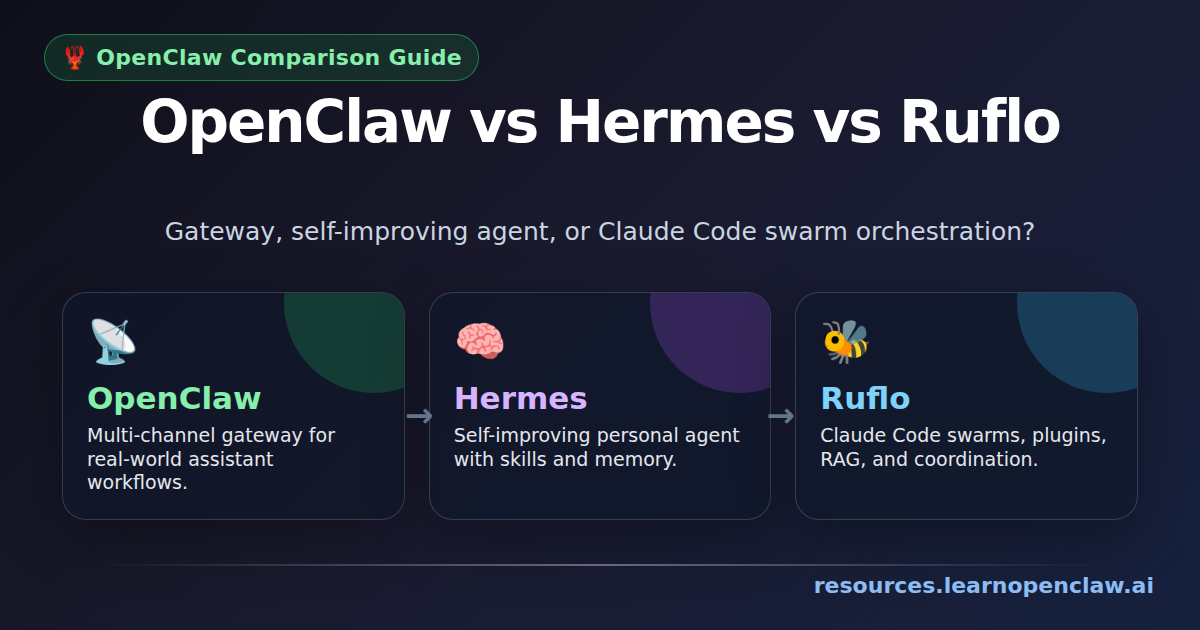
The short version: OpenClaw is the practical messaging gateway, Hermes is the self-improving personal agent runtime, and Ruflo is the Claude Code swarm/orchestration layer. They overlap, but they are not interchangeable.
This comparison is written for builders, operators, and technical founders who want a clear answer to a real question: which one should I run for my actual workflow?
The quick verdict
| If you need… | Pick… | Why |
|---|---|---|
| A phone-first assistant across Telegram, WhatsApp, Slack, Discord, iMessage, Signal, and more | OpenClaw | It is built around the gateway/channel problem first. |
| A personal agent that learns your workflows and turns repeated work into skills | Hermes Agent | Its core pitch is the closed learning loop: memory, skills, recall, and improvement over time. |
| Claude Code multi-agent swarms, RAG memory, plugins, and enterprise-style coordination | Ruflo | It extends Claude Code with agent orchestration, memory, hooks, MCP, federation, and background workers. |
| A teachable, reliable automation system for tutorials and non-technical users | OpenClaw | The mental model is simple: connect channels, route messages, run agents, report results. |
| An ambitious research-grade local/remote agent lab | Hermes or Ruflo | Hermes leans into personal learning; Ruflo leans into swarms, plugins, and large tool surfaces. |
What these tools actually are
OpenClaw: the self-hosted gateway for AI agents
OpenClaw is best understood as a gateway. You run one process on your machine or server, connect your messaging channels, and talk to AI agents from wherever you already live: Telegram, WhatsApp, Discord, Slack, iMessage, Signal, Matrix, Google Chat, Microsoft Teams, Zalo, and more.
Its strength is not that it tries to be the smartest agent brain. Its strength is that it gives agents a reliable nervous system: channels, routing, sessions, memory, media, cron jobs, background tasks, multi-agent routing, mobile nodes, and a browser control UI.
That makes OpenClaw especially strong for:
- Personal assistants you can message from your phone
- Business automations that need to report into chat
- Scheduled research, monitoring, and publishing workflows
- Multi-channel support where Telegram today may become WhatsApp or Slack tomorrow
- Teaching agent automation because the mental model is easy to explain
Hermes Agent: the self-improving personal agent
Hermes Agent is an open-source agent from Nous Research. Its strongest claim is not just that it can run tools, talk through messaging apps, or schedule jobs. The interesting part is that Hermes is designed to improve through use.
Hermes emphasizes a closed learning loop: it can create and improve skills from experience, persist knowledge, search past conversations, build a model of the user, and reuse procedural memory. It also supports multiple model providers, local models, different terminal backends, messaging gateways, cron scheduling, and isolated subagents.
Hermes is compelling when your question is: how do I make my personal agent get better at my recurring workflows over time?
Hermes Studio: the browser control plane for Hermes
There is also Hermes Studio, a self-hosted dashboard for Hermes Agent. This matters because it makes Hermes feel less like a terminal-only project and more like an operating console.
Hermes Studio adds browser-based chat, memory browsing, skills management, cron job management, execution approvals, MCP server management, visual workflows, crew templates, cost tracking, logs, analytics, and mobile-friendly PWA access. If you are comparing user experience, Hermes plus Hermes Studio is the fair comparison — not just the Hermes CLI alone.
Ruflo: Claude Code orchestration, swarms, plugins, and memory
Ruflo is different again. It positions itself as an agent orchestration platform for Claude, especially Claude Code. It gives Claude Code a broader coordination layer: agents, swarms, memory, hooks, MCP tools, background workers, plugins, federation, RAG, security auditing, and multi-provider routing.
Ruflo is not trying to be a simple phone gateway first. It is trying to make many agents coordinate. If OpenClaw is a gateway and Hermes is a learning personal agent, Ruflo is closer to an agent operating platform for complex Claude Code workflows.
The comparison most articles miss
Existing OpenClaw-vs-Hermes comparisons usually focus on two dimensions: channels and memory. That is useful, but incomplete. They often miss three practical questions:
- Where does the human actually interact with the agent? Phone, terminal, web UI, IDE, or Claude Code?
- What is the unit of automation? A chat message, a recurring job, a skill, a multi-agent mission, or a swarm?
- How much orchestration do you really need? One assistant that gets things done is very different from 100 agents coordinating with shared memory.
That is why this should not be framed as one universal winner. The right choice depends on where you want the agent to live.
Architecture: gateway vs agent runtime vs orchestration layer
The fastest way to understand the difference is to look at the center of gravity.
| Tool | Center of gravity | Best mental model |
|---|---|---|
| OpenClaw | Gateway, channels, routing, sessions, nodes | “Message my agent from anywhere.” |
| Hermes | Agent runtime, memory, skills, self-improvement | “My assistant learns how I work.” |
| Ruflo | Claude Code orchestration, swarms, plugins, MCP, memory | “Coordinate many agents around complex work.” |
OpenClaw gives you a durable bridge between humans, chat platforms, and agent backends. Hermes gives you an agent that tries to learn the recurring procedures behind your work. Ruflo gives you a coordination layer when one agent is not enough.
Messaging channels and remote access
This is where OpenClaw is strongest. OpenClaw is explicitly built around the idea that your agent should be reachable through normal messaging apps. A single Gateway can serve multiple built-in and plugin channels at once, including Telegram, WhatsApp, Discord, Slack, Signal, iMessage, Matrix, Google Chat, Microsoft Teams, Zalo, and more.
Hermes also supports messaging gateways, including Telegram, Discord, Slack, WhatsApp, Signal, and CLI entry points. For many personal users, that is already enough. But OpenClaw’s channel breadth and routing model make it the better fit when channel coverage is the product.
Ruflo is less about being reachable from every chat app and more about extending Claude Code. It can expose web UIs and MCP-style workflows, but if the primary requirement is “I want my assistant in Telegram, WhatsApp, and Slack with clean routing,” OpenClaw is the simpler pick.
Memory and learning
Hermes has the strongest explicit learning story. Its README describes skill creation, skill improvement, cross-session search, persistent knowledge, user modeling, and procedural memory. If your repeated work looks like “research this kind of thing every week, remember how I like it, improve the playbook,” Hermes is attractive.
OpenClaw also has memory, context files, active memory, session history, and skills. In practice, OpenClaw’s memory system is excellent for continuity and personalization across channels. But OpenClaw’s main identity is still gateway-first, not learning-loop-first.
Ruflo’s memory story is broader and more infrastructure-heavy: AgentDB, vector search, RAG memory, knowledge graphs, swarm memory, and plugin-based retrieval. That can be powerful, but it also adds surface area. If you want lightweight continuity, it may be overkill. If you want coordinated agents sharing retrieval and plans, it is exactly the point.
Multi-agent work
All three can support some version of multi-agent work, but they mean different things by it.
- OpenClaw: multi-agent routing, isolated sessions, sub-agents, background tasks, and channel-aware delegation.
- Hermes: isolated subagents, Python RPC, skill reuse, and Hermes Studio crews/conductor-style orchestration.
- Ruflo: swarms, topologies, many specialized agents, consensus, plugins, federation, background workers, and Claude Code hooks.
If you need a personal assistant to delegate a research branch while it keeps working, OpenClaw or Hermes is enough. If you want a platform that advertises 100+ specialized agents, swarm topologies, plugin packs, and federated collaboration, Ruflo is built for that ambition.
Install and first-run experience
OpenClaw’s basic install is straightforward:
$ npm install -g openclaw@latest
$ openclaw onboard --install-daemon
$ openclaw dashboard
Hermes offers a shell installer and a direct CLI:
$ curl -fsSL https://raw.githubusercontent.com/NousResearch/hermes-agent/main/scripts/install.sh | bash
$ hermes
$ hermes gateway
Ruflo’s full path is typically initialized into a Claude Code workspace:
$ npx ruflo@latest init wizard
$ claude mcp add ruflo -- npx ruflo@latest mcp start
The important distinction is not just command count. OpenClaw onboarding asks, “which channels and agents do you want?” Hermes asks, “which model, tools, memory, and gateway do you want?” Ruflo asks, “how much orchestration should Claude Code have inside this workspace?”
Security and operational risk
Agent frameworks are powerful because they can do real things. That is also why they need careful boundaries.
For OpenClaw, the operational priority is channel authorization, group mention rules, approval modes, tool policy, secrets hygiene, and keeping the gateway updated. Because OpenClaw is often reachable from chat platforms, the channel boundary matters a lot.
For Hermes, the priority is terminal backend choice, tool permissions, skill trust, memory hygiene, and approval policy. Hermes Studio adds a useful browser approval layer, but browser access itself becomes something you need to protect.
For Ruflo, the risk is complexity. Swarms, plugins, MCP servers, federation, memory stores, and hooks are powerful, but every added component is another boundary to configure. Ruflo is exciting, but it is not the first tool I would hand to a non-technical operator.
Where OpenClaw wins
- Channel breadth: OpenClaw is the best choice when the assistant must live in many messaging apps.
- Teaching clarity: It is easier to explain: messages come in, the Gateway routes them, the agent acts, results go back out.
- Operational workflows: Cron jobs, alerts, reports, blog publishing, social monitoring, and admin tasks map naturally to OpenClaw.
- Multi-surface UX: Chat channels, web UI, mobile nodes, media, voice, and background tasks all fit the same gateway model.
- Personal/business automation: If the goal is a useful assistant that reports into Telegram or Slack, OpenClaw gets there cleanly.
Where Hermes wins
- Self-improvement: Hermes has the clearest product-level commitment to skills that improve through use.
- Personal agent continuity: It is designed to build a deeper picture of the user and recurring procedures.
- Model openness: Hermes highlights broad provider support, local models, and open-model ecosystems.
- Hermes Studio: The dashboard gives Hermes a serious control-plane story for approvals, jobs, skills, logs, memory, and crews.
- Research direction: If you care about trajectory generation and training tool-calling models, Hermes has more obvious research hooks.
Where Ruflo wins
- Claude Code orchestration: Ruflo is built for people who already live in Claude Code and want more coordination.
- Swarms and plugins: It offers a much bigger orchestration surface than a simple personal assistant.
- Memory infrastructure: AgentDB, RAG, vector search, knowledge graphs, and self-learning patterns are central to the pitch.
- Enterprise-style architecture: Federation, security plugins, audit workers, observability, cost tracking, and workflow templates fit larger teams.
- Ambitious automation labs: If you want to experiment with many agents, Ruflo is the most expansive of the three.
The honest recommendation
For most people building a real assistant today, I would start with OpenClaw. Not because it has every feature on the longest checklist, but because it solves the most common real-world problem: how do I talk to my agent from the places I already communicate, and how do I make it reliably report back?
If, after a few weeks, your pain becomes “my agent keeps re-learning the same workflows,” then Hermes deserves a serious look. Its learning-loop orientation is not a gimmick; it is the right direction for personal agents.
If your pain becomes “one agent is not enough; I need coordinated specialized agents around Claude Code,” then Ruflo becomes interesting. But Ruflo should be adopted deliberately. It has power, but power comes with operational complexity.
Practical decision tree
- Choose OpenClaw if your first sentence is “I want to message my AI assistant from Telegram/WhatsApp/Slack/Discord and have it do work.”
- Choose Hermes if your first sentence is “I want a personal agent that learns my workflows and improves over time.”
- Choose Ruflo if your first sentence is “I want Claude Code to coordinate many agents, memory systems, plugins, and background workers.”
- Use OpenClaw plus another tool if your first sentence includes both messaging and deep orchestration. OpenClaw can be the human-facing gateway while another backend handles specialized execution.
Could you combine them?
Yes, but do not over-engineer the first version.
A practical architecture could look like this:
- OpenClaw handles Telegram, Slack, WhatsApp, approvals, alerts, and delivery.
- Hermes handles a learning-heavy personal workflow where procedural memory matters.
- Ruflo handles a Claude Code workspace where multiple agents need to coordinate on software projects.
That combination is powerful, but it is also three systems to operate. My strong recommendation: start with one, prove the workflow, then add the second only when you can name the missing capability precisely.
Final take
OpenClaw, Hermes, and Ruflo are converging on the same future: agents that are reachable, stateful, tool-using, scheduled, multi-agent, and increasingly self-improving. But they are approaching that future from different starting points.
OpenClaw starts from communication. It asks: how do humans reach agents from anywhere?
Hermes starts from learning. It asks: how does an agent improve as it works with you?
Ruflo starts from orchestration. It asks: how do many agents coordinate around complex work?
If you remember only one thing, make it this: OpenClaw is the best default for real-world assistant workflows, Hermes is the strongest bet for compounding personal memory, and Ruflo is the power-user choice for Claude Code swarms.